
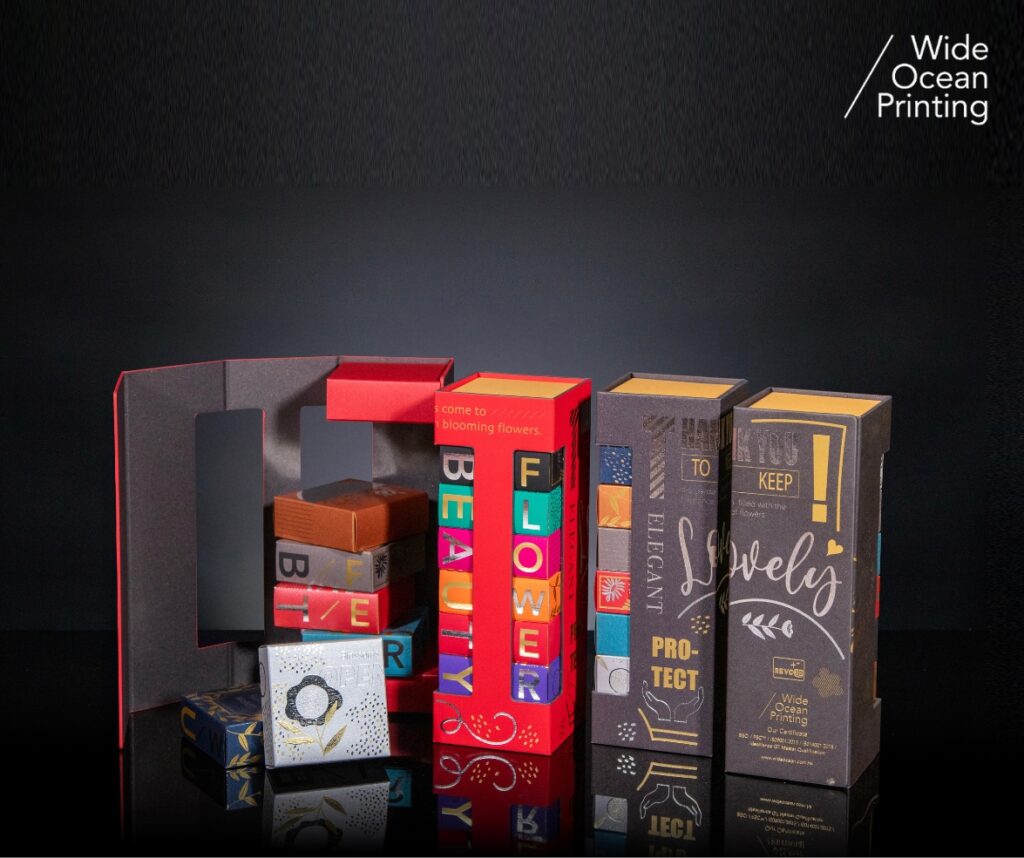
In packaging production, mounting is often seen as a intermediate process — attaching a printed sheet to greyboard or thick card so the structure feels stronger and more rigid and substantial. In practice, however, its impact goes far beyond appearance and thickness. Mounting directly affects whether the subsequent steps of die-cutting, folding, and box gluing can proceed smoothly and accurately. In other words, mounting is not just about bonding surfaces — it forms a critical foundation for the entire production sequence. 📦
🟣 Layer One: Surface flatness affects die-cut precision
Once the printed face paper is mounted onto board, any bubbles, wrinkles, shifting, or uneven tension can compromise the next die-cutting stage. Problems such as torn edges, rough cuts, weak creases, or inaccurate cut lines often become more likely when the mounted surface is not stable. This is especially noticeable in premium gift boxes, rigid boxes, and structures with custom windows. Although die-cutting happens later, its precision is often determined much earlier — at the mounting stage. ✂️
🟡 Layer Two: Thickness and tension affect folding behavior
After mounting, the sheet is no longer a single material but a combined structure. Creasing must therefore account for total thickness, rebound, and grain direction. If the mounted board carries too much tension, fold lines may feel stiff or unstable. If crease depth is not adjusted properly, cracking, whitening, or uneven folding may appear. Although these problems usually become visible during folding, they are often rooted in the way the board was mounted in the first place. 📐
🟢 Layer Three: Mounting accuracy also influences box gluing efficiency
For a box to glue properly and hold its shape, each panel must align correctly and each crease must fold as intended. If the mounting stage already introduces slight positional shifts, later die-cutting and creasing may also be affected, leading to uneven joints, misaligned corners, or unstable edges during gluing. In mass production, these small inaccuracies can accumulate across many pieces, reducing both efficiency and consistency. This is why mounting precision is not just about appearance — it directly affects production reliability. 🛠️
🔵 Layer Four: When the early stage is stable, the later stages run better
From a workflow perspective, mounting, die-cutting, folding, and gluing should not be viewed as isolated processes. They form one continuous path toward structure. When flatness, positioning, and material tension are controlled well during mounting, the following stages become easier to manage, and the final package is more likely to preserve the intended proportions, feel, and quality.
✨ Conclusion
The value of mounting lies not only in making packaging feel thicker or more rigid and substantial, but in creating a reliable base for all the processes that follow. When the sheet is accurately bonded, tension is controlled, and the board stays stable, the entire forming process becomes smoother — and the final result becomes cleaner, stronger, and more refined.
“Every design deserves the right finishing.”
Reach out to our team for
tailored recommendations, sample references, and accurate cost estimates.